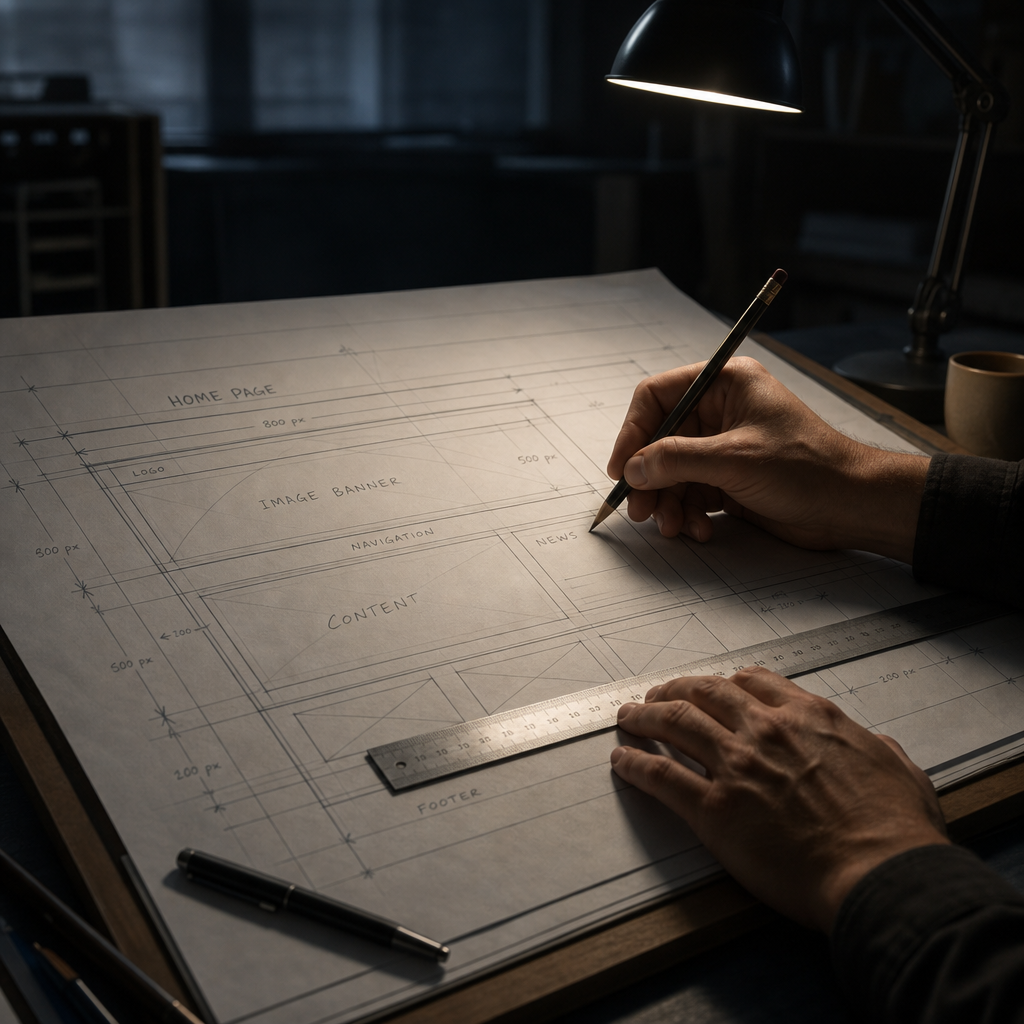
Twenty years is a long time to be in any industry. It is long enough to watch entire paradigms appear, dominate, and disappear. It is long enough to have built websites on technology that no longer exists, for clients whose businesses have since closed, pivoted, or outgrown what the web used to be. And it is long enough to know, with some certainty, what actually matters and what is just noise.
Innovate Web Development was founded in Omaha, Nebraska, by Eric English — a web designer and developer who came to the work by an unlikely route. Eric holds a master's degree in philosophy and had planned to pursue it as a career. When that path closed, he needed to find a new one. What he carried with him was a way of thinking: break a problem down to its foundations, understand it completely, then build something from what you find. He applied that method to HTML and CSS, and it turned out to work just as well on code as it did on arguments. That is still true today. But almost everything else about how IWD operates is being rebuilt from scratch, deliberately, and in public.
This is the story of what twenty years of web design — the last nine of them in Grand Rapids, Michigan — actually looks like, and what comes next.
What Web Design Looked Like in the Beginning
When Eric started building websites, the web was a different place. Table-based layouts were still common. CSS3 and HTML5 were new — genuinely exciting developments that the industry was just starting to wrap its hands around. JavaScript was an afterthought. Mobile didn't exist as a consideration, because no one was browsing on a phone.
The work required a different kind of problem-solving. There were no frameworks to reach for, no libraries to install. You read the code, you figured out what it did, and you made it do something new. That process — breaking things down until they made sense, then building them back up — became the foundation of how IWD approached every project.
"I never said no to a project," Eric explains, "because I knew I could learn whatever I needed to in order to complete it." That willingness to figure things out on the fly, to take on what was unfamiliar rather than what was comfortable, is not a historical footnote. It is how the company still operates today.
The Problem With Subcontracting: A Cautionary Tale
For roughly a decade, IWD operated in a productive but increasingly complicated arrangement. Eric partnered with another developer whose primary expertise was in hosting and servers — a natural complement to IWD's design and development focus. Business was good. Clients were plentiful. The work was steady.
The problem is that it was someone else's work.
Over time, the arrangement created a dependency that went unexamined for too long. IWD had effectively become a subcontractor — skilled, reliable, and invisible. The clients belonged to someone else. The pricing was controlled by someone else. The growth, or lack of it, was determined by someone else's decisions.
This is a pattern that is more common in web design than most people in the industry will admit. It is easy to keep your head down and build things, especially when the technical work is something you genuinely love. The business side, the marketing, the development of an independent client base — those things require a different kind of effort. For a long time, IWD deprioritized them.
The result: a strong skill set with a thin client list, and a company that had spent years building other people's brands without building its own.
What Twenty Years Actually Teaches You
There are things you cannot learn about web design except by doing it for a very long time. Not from tutorials, not from certifications, not from case studies written by people who are trying to sell you something.
Here is what two decades of building websites for small businesses has taught IWD:
Most websites fail their owners before they fail technically. The site loads fine. The images are there. The contact form works. But the messaging is vague, the structure doesn't guide anyone anywhere, and the business it represents is indistinguishable from its competitors. Technical competence is the floor, not the ceiling.
SEO is not magic, and anyone who tells you otherwise is selling something. Real search engine optimization is cause and effect. It is a set of decisions — about content, structure, speed, credibility, and specificity — that either give search engines a reason to trust your site or don't. There are no shortcuts. There are no tricks. There is only evidence, accumulated over time, that your site deserves to be found.
The web moves fast, but the fundamentals don't. Platforms change. Algorithms update. Design trends cycle through. But the underlying questions — Does this load quickly? Does this communicate clearly? Does this make someone trust the business enough to reach out? — have been the same for twenty years. They will be the same for twenty more.
A web presence is never finished. The small businesses that treat a website as a one-time expense tend to find, a few years later, that they have a liability instead of an asset. The ones that treat it as an ongoing investment — updating content, monitoring performance, adapting to how their customers are searching — consistently outperform. This is not a sales pitch. It is just what the data shows.
What IWD Is Doing Differently Now
The reinvention of Innovate Web Development is not cosmetic. It is structural.
The first change is the website itself. The IWD site has been rebuilt entirely on a modern stack — moving away from WordPress as a front-end framework to Astro, a static site generator that produces faster, leaner, more flexible output. This was not a trend decision. It was a performance decision. For a web design company in Grand Rapids that talks to clients about page speed and Core Web Vitals, having a slow site is a contradiction that was no longer acceptable.
The second change is documentation. IWD is now actively recording its own SEO process — keyword research, structural decisions, content choices, ranking changes — from day one of the rebuild. Not to produce content for content's sake, but to build a real, evidence-based record of what works. If this site ranks for "web design Grand Rapids" six months from now, there will be a paper trail explaining exactly why. If something doesn't work, that will be documented too.
The third change is positioning. IWD is no longer operating as an invisible partner in someone else's workflow. The company is building direct client relationships — the kind where IWD's name is attached to the work, where the pricing reflects the actual value of two decades of expertise, and where the goal is a genuine partnership between the agency and the business it serves.
That word — partnership — matters. It is not a marketing term here. It means that IWD's success is tied directly to its clients' success. A website that doesn't bring in business is not a success, regardless of how it looks. The measure is always what it does, not what it is.
What Comes Next
The web is crowded. Mass-produced websites built on the same templates, optimized for the same keywords, saying the same things in the same order. The result is a kind of digital noise where nothing stands out and no one is really speaking to anyone.
Most agencies are too busy executing to stop and ask whether any of it is actually working. IWD is taking a different approach — stepping back, slowing down, and reimagining what a website is supposed to do in the first place.
Here is what twenty years of working with small businesses makes clear: the most powerful marketing tool any business has is its relationships. When you start a business, the first people who know are your friends, your family, people from church, people in your network. They are the ones who send someone your way when that person has a problem you can solve. They do not recommend things people do not need. That referral carries trust that no ad campaign can manufacture.
When that referred person lands on your website, they are not a stranger. They are already halfway convinced. The website's job is to finish that conversation — to reflect the personality of the business so clearly that the right person immediately knows they are in the right place.
That is what IWD builds. Not websites for everyone. Websites for the right people. Because new clients are not new people. They are just new relationships.
That is worth reimagining everything for.
Ready to talk about your web presence?
Get in Touch