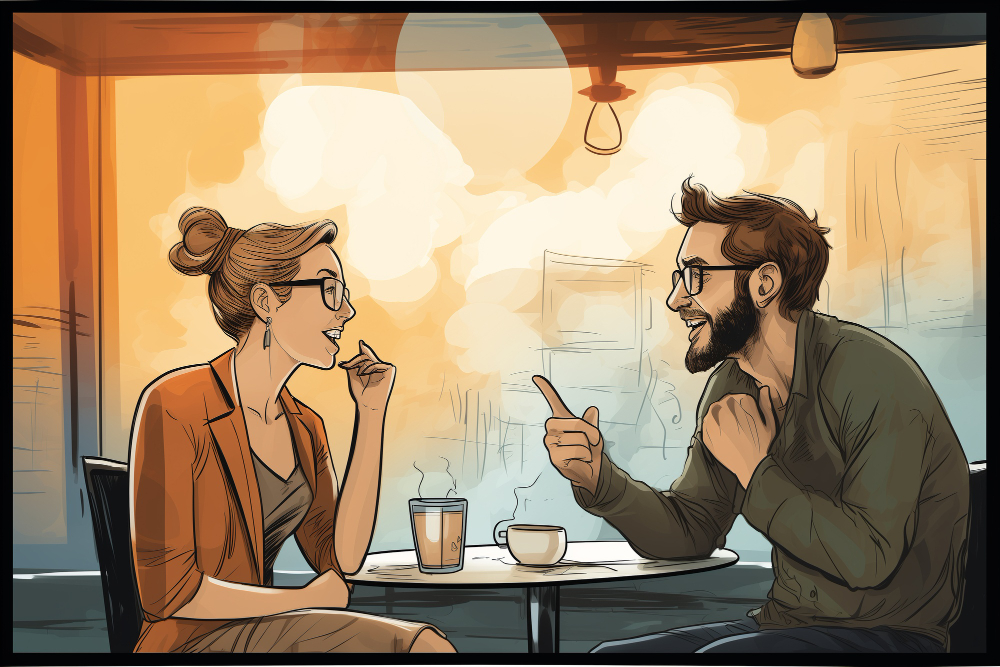
A friend of mine moved across the country last year and within two weeks had a dentist, a barber, and a go-to taco place lined up. None of it came from a Google search. Someone in her new building mentioned the taco place in passing. Her coworker's husband cuts hair on the side. The dentist was a name three different people brought up unprompted, all describing the same thing: he explains what he's doing before he does it, and he doesn't try to sell you a crown you don't need.
That's marketing. Not the kind with a budget line or a campaign brief, but the kind that actually moves people to act. And it didn't come from a brand. It came from people talking to other people about an experience that mattered enough to repeat.
This is worth sitting with, because most marketing advice spends its energy on the wrong layer. Channels change. Algorithms change. The platform everyone swears by this year will be half-abandoned in three. Strip away the tactics, though, and what's left hasn't moved in thousands of years: people decide what to trust based on other people, and they remember what to trust based on the story they were told about it.
Facts Inform. Stories Move.
Tell someone your product reduces churn by 14 percent and they'll nod and forget it by lunch. Tell them about the customer who almost walked away, the late-night call from your support team, and the renewal six months later that came with a handwritten thank-you note, and they'll remember the shape of it long after the number is gone.
This isn't a knock on data. Data tells you whether something worked. Story tells you why it mattered, and "why it mattered" is the part that gets repeated at dinner, dropped into a Slack channel, or mentioned to a coworker who just happens to be looking for exactly what you sell. A statistic is information. A story is a unit that travels.
The companies that seem to have an unfair advantage in word of mouth usually aren't doing anything mysterious. They've just figured out how to make their product, their service, or their founder's reasoning into something a customer can retell in thirty seconds without sounding like they're reading off a brochure. Patagonia doesn't lead with jacket specs. Liquid Death didn't get talked about because canned water is inherently interesting. The product becomes a vehicle for a story the customer wants to be part of, and once they're part of it, they tell it for you.
Word of Mouth Is the Oldest Conversion Funnel There Is
Long before "funnel" was a marketing term, it was just how trust worked. You used the blacksmith your neighbor used. You bought from the merchant your cousin vouched for. The economy of a small town ran on reputation passed hand to hand, and the most effective form of advertising was simply being the kind of business people felt good recommending.
What's changed isn't the mechanism. It's the speed and the reach. A recommendation that used to travel across a street now travels across a country in the time it takes to send a text. But the psychology underneath it is the same as it was in a village market five hundred years ago: people don't want to be sold to, they want to be told the truth by someone they trust, and then they want to pass that truth along, partly because it helps the next person and partly because it makes the teller look good for knowing something worth sharing.
This is also why so much paid advertising underperforms relative to its cost. It's competing with a system refined by human social instinct over the entire span of recorded history. An ad can interrupt someone's attention. It rarely earns their trust the way a friend's offhand comment does.
Every Marketing Decision Is Really a Relationship Decision
Pull apart any marketing function and there's a relationship sitting underneath it. A brand voice is a decision about how you want to talk to someone, the same way you'd choose your tone with a friend versus a stranger. A loyalty program is a formalized version of remembering someone's usual order. An email sequence, at its best, reads like a person checking in, not a system firing on a schedule. Even pricing, cold as it sounds, is a statement about what kind of relationship you're proposing: transactional and disposable, or ongoing and earned.
This is also why so much marketing feels hollow. Somewhere along the way, the relationship gets replaced by the apparatus meant to simulate it: automated drip campaigns that never adjust to what the person actually said, chatbots that perform warmth without any memory of the last conversation, testimonials that read like they were written by the same copywriter five different times. People can feel the difference between being known and being processed, even when they can't quite articulate why one interaction felt fine and another felt off.
Where This Actually Shows Up on a Website
For anyone building or running a website, this isn't an abstract idea to admire from a distance. It shows up in concrete decisions. The "About" page that tells you who actually built the thing and why, instead of reciting a mission statement assembled from corporate Mad Libs. A case study that follows one real client's actual problem instead of a vague composite of three. A contact form that gets a reply from an actual human within a day, because that single interaction often does more for word of mouth than the next six months of ad spend combined.
It also shows up in what a site chooses to leave out. The fastest way to kill a story is to bury it under jargon, stock photography of people laughing at salads, and a homepage that could belong to any company in the category. If a visitor can't tell what makes you different after thirty seconds, they have nothing to repeat to anyone else. A story that can't be repeated can't spread.
The Relationship Was Always the Point
None of this means tactics don't matter. SEO gets you found. Paid ads can buy attention you haven't earned yet. Email and social media move information at a scale no individual conversation ever could. But all of it is plumbing. It moves the story to the person; it doesn't replace the need for the story, and it definitely doesn't replace the relationship the story is meant to build.
The dentist my friend found didn't run a single ad that reached her. He just kept being the kind of person three separate strangers wanted to talk about. That's not a marketing hack. That's the whole job, and it always has been.
Want a website that gives people something worth repeating?
Get in Touch